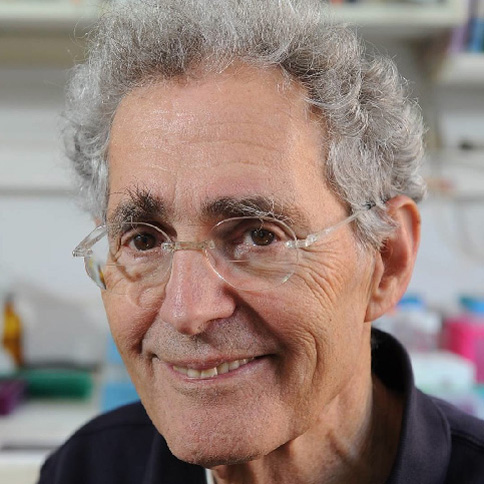
Pierre R. Deligne

Wolf Prize Laureate in Mathematics 2008/9

Pierre R. Deligne


Affiliation at the time of the award:

Institute for Advanced Study, Princeton, USA


Award citation:

“for his work on mixed Hodge theory, the Weil conjectures, the Riemann-Hilbert correspondence, and for his contributions to arithmetic”.


Prize share:

Pierre R. Deligne

David B. Mumford

Phillip A. Griffiths


Central to modern algebraic geometry is the theory of moduli, i.e., variation of algebraic or analytic structure. This theory was traditionally mysterious and problematic. In critical special cases, i.e., curves, it made sense, i.e., the set of curves of genus greater than one had a natural algebraic structure. In dimensions greater than one, there was some sort of structure locally, but globally everything remained mysterious. The two main (and closely related) approaches to moduli were invariant theory on the one hand and periods of abelian integrals on the other. This key problem was tackled and greatly elucidated by Deligne, Griffiths, and Mumford.

Professor David B. Mumford revolutionized the algebraic approach through invariant theory, which he renamed “geometric invariant theory”. With this approach, he provided a complicated prescription for the construction of moduli in the algebraic case. As one application he proved that there were a set of equations defining the space of curves, with integer coefficients. Most important, Mumford showed that moduli spaces, though often very complicated, exist except for what, after his work, are well-understood exceptions. This framework is critical for the work by Griffiths and Deligne. Classically, the moduli space of curves was parameterized by using periods of the abelian integrals on them. Mathematicians, e.g., the Wolf Prize winner Andre Weil, have unsuccessfully tried to generalize the periods to higher dimensions.

Professor Phillip A. Griffiths had the fundamental insight that the Hodge filtration measured against the integer homology generalizes the classical periods of integrals. Moreover, he realized that the period mapping had a natural generalization as a map into a classifying space for variations of Hodge structure, with a new non-classical restriction imposed by the Kodaira-Spencer class action. This led to a great deal of work in complex differential geometry, e.g., his basic work with Deligne, John Morgan, and Dennis Sullivan on rational homotopy theory of compact Kaehler manifolds.

Building on Mumford´s and Griffiths´ work, Professor Pierre R. Deligne demonstrated how to extend the variation of Hodge theory to singular varieties. This advance, called mixed Hodge theory, allowed explicit calculation on the singular compactification of moduli spaces that came up in Mumford´s geometric invariant theory, which is called the Deligne-Mumford compactification. These ideas assisted Deligne in proving several other major results, e.g., the Riemann-Hilbert correspondence and the Weil conjectures.

Phillip A. Griffiths

Wolf Prize Laureate in Mathematics 2008/9

Phillip A. Griffiths


Affiliation at the time of the award:

Institute for Advanced Study, Princeton, USA


Award citation:

“for his work on variations of Hodge structures, the theory of periods of abelian integrals, and for his contributions to complex differential geometry”.


Prize share:

Phillip A. Griffiths

David B. Mumford

Pierre R. Deligne


Central to modern algebraic geometry is the theory of moduli, i.e., variation of algebraic or analytic structure. This theory was traditionally mysterious and problematic. In critical special cases, i.e., curves, it made sense, i.e., the set of curves of genus greater than one had a natural algebraic structure. In dimensions greater than one, there was some sort of structure locally, but globally everything remained mysterious. The two main (and closely related) approaches to moduli were invariant theory on the one hand and periods of abelian integrals on the other. This key problem was tackled and greatly elucidated by Deligne, Griffiths, and Mumford.

Professor David B. Mumford revolutionized the algebraic approach through invariant theory, which he renamed “geometric invariant theory”. With this approach, he provided a complicated prescription for the construction of moduli in the algebraic case. As one application he proved that there were a set of equations defining the space of curves, with integer coefficients. Most important, Mumford showed that moduli spaces, though often very complicated, exist except for what, after his work, are well-understood exceptions. This framework is critical for the work by Griffiths and Deligne. Classically, the moduli space of curves was parameterized by using periods of the abelian integrals on them. Mathematicians, e.g., the Wolf Prize winner Andre Weil, have unsuccessfully tried to generalize the periods to higher dimensions.

Professor Phillip A. Griffiths had the fundamental insight that the Hodge filtration measured against the integer homology generalizes the classical periods of integrals. Moreover, he realized that the period mapping had a natural generalization as a map into a classifying space for variations of Hodge structure, with a new non-classical restriction imposed by the Kodaira-Spencer class action. This led to a great deal of work in complex differential geometry, e.g., his basic work with Deligne, John Morgan, and Dennis Sullivan on rational homotopy theory of compact Kaehler manifolds.

Building on Mumford’s and Griffiths’ work, Professor Pierre R. Deligne demonstrated how to extend the variation of Hodge theory to singular varieties. This advance, called mixed Hodge theory, allowed explicit calculation on the singular compactification of moduli spaces that came up in Mumford’s geometric invariant theory, which is called the Deligne-Mumford compactification. These ideas assisted Deligne in proving several other major results, e.g., the Riemann-Hilbert correspondence and the Weil conjectures.

John A. Pickett

Wolf Prize Laureate in Agriculture 2008/9

John A. Pickett


Affiliation at the time of the award:

Rothamsted Research, United Kingdom


Award citation:

“for their remarkable discoveries of mechanisms governing plant-insect and plant-plant interactions. Their scientific contributions on chemical ecology have fostered the development of integrated pest management and significantly advanced agricultural sustainability”.


Prize share:

John A. Pickett

W. Joe Lewis

James H. Tumlinson


The research efforts of John A. Pickett, James H. Tumlinson and W. Joe Lewis have led to a paradigm shift in integrated pest management in agriculture. For many years, Professor John A. Pickett has contributed significantly to the field of chemical ecology and agriculture worldwide, and has achieved an international reputation equaled by few. He has opened up new areas of research with novel approaches and then applied basic research results by developing innovative control strategies for agricultural pests and weeds. By integrating techniques from molecular biology, electrophysiology, biochemistry and behavior, he has positioned himself at the cutting-edge of the field. As a result, Pickett has become a world leader in the development of sustainable, environmentally-sound methods of insect pest management, based on use of semio-chemicals to manipulate the behavior of pests and their natural enemies.

Professor James H. Tumlinson and Professor W. Joe Lewis have been a major force in reorienting the thinking of agricultural scientists and educators toward a more ecologically sound approach to pest management. Their research has demonstrated the sophisticated natural system of biological interaction between plants, insects feeding on plants, and predators and parasitoids of these herbivores. The impressive contributions of Lewis and Tumlinson in developing and applying scientific understanding have shifted the pest management agenda worldwide.

James H. Tumlinson

Wolf Prize Laureate in Agriculture 2008/9

James H. Tumlinson


Affiliation at the time of the award:

Pennsylvania State University, USA


Award citation:

“for their remarkable discoveries of mechanisms governing plant-insect and plant-plant interactions. Their scientific contributions on chemical ecology have fostered the development of integrated pest management and significantly advanced agricultural sustainability”.


The research efforts of John A. Pickett, James H. Tumlinson and W. Joe Lewis have led to a paradigm shift in integrated pest management in agriculture. For many years, Professor John A. Pickett has contributed significantly to the field of chemical ecology and agriculture worldwide, and has achieved an international reputation equaled by few. He has opened up new areas of research with novel approaches and then applied basic research results by developing innovative control strategies for agricultural pests and weeds. By integrating techniques from molecular biology, electrophysiology, biochemistry and behavior, he has positioned himself at the cutting-edge of the field. As a result, Pickett has become a world leader in the development of sustainable, environmentally-sound methods of insect pest management, based on use of semio-chemicals to manipulate the behavior of pests and their natural enemies.

Professor James H. Tumlinson and Professor W. Joe Lewis have been a major force in reorienting the thinking of agricultural scientists and educators toward a more ecologically sound approach to pest management. Their research has demonstrated the sophisticated natural system of biological interaction between plants, insects feeding on plants, and predators and parasitoids of these herbivores. The impressive contributions of Lewis and Tumlinson in developing and applying scientific understanding have shifted the pest management agenda worldwide.

Howard Cedar

Wolf Prize Laureate in Medicine 2008/9

Howard Cedar 


Affiliation at the time of the award:

The Hebrew University of Jerusalem, Israel


Award citation:

“for their fundamental contributions to our understanding of the role of DNA methylation in the control of gene expression”.


Prize share:

Howard Cedar 

Aharon Razin


The pioneering studies of Professor Howard Cedar and Professor Aharon Razin of the role of DNA methylation in the biological function of higher organisms has had widespread impact on studies in the fields of development, control of gene expression, epigenetics and cancer research. Their earliest experiments helped determine the patterns of DNA methylation in vivo, and their correlation with the suppression of gene expression. They then linked these methylation patterns to the recruitment of histone modifications associated with gene inactivation. In another extremely important contribution, they showed how DNA methylation patterns are laid down, erased, and reestablished in sperm, oocytes, and early embryonic development. These results are of the greatest significance for understanding the epigenetic transmission of expression patterns, particularly for imprinted genes, and are critical to the study of imprinting malfunctions in humans, which give rise to many congenital defects. The changes in methylation patterns are also critical events for the control of embryonic development, and their control will be essential in any extensive development of methods for exploiting the developmental potential of embryonic stem cells. There are also strong connections between their work and a major theme in cancer research, the marked de novo methylation of DNA cells. In summary, their experiments have been critical for establishing the fundamental role of DNA methylation in the control of gene expression.

Giya Kancheli

Wolf Prize Laureate in Music 2008/9

Giya Kancheli


Award citation:

“Giya Kancheli is one of the world’s greatest contemporary composers, whose unique music is infused with unforgettable beauty”.


Prize share:

Giya Kancheli 

Claudio Abbado


His remarkable symphonies alternate between surrealistic serenity and an almost violent outburst of intensity. Kancheli´s music expresses the full range of human emotions, from deep religiosity to effusive passion, and from optimism to pessimism. His music connects between an aura of mysticism and realistic depictions.

Through his music, of immense depths, Kancheli has become a source of worldwide influence, most especially on the younger generation of composers.


David B. Mumford

Wolf Prize Laureate in Mathematics 2008/9

David B. Mumford


Affiliation at the time of the award:

Brown University, USA


Award citation:

“for his work on algebraic surfaces, on geometric invariant theory, and for laying the foundations of the modern algebraic theory of moduli of curves and theta functions”.


Prize share:

David B. Mumford

Phillip A. Griffiths

Pierre R. Deligne


Central to modern algebraic geometry is the theory of moduli, i.e., variation of algebraic or analytic structure. This theory was traditionally mysterious and problematic. In critical special cases, i.e., curves, it made sense, i.e., the set of curves of genus greater than one had a natural algebraic structure. In dimensions greater than one, there was some sort of structure locally, but globally everything remained mysterious. The two main (and closely related) approaches to moduli were invariant theory on the one hand and periods of abelian integrals on the other. This key problem was tackled and greatly elucidated by Deligne, Griffiths, and Mumford.

Professor David B. Mumford revolutionized the algebraic approach through invariant theory, which he renamed ‘geometric invariant theory.’ With this approach, he provided a complicated prescription for the construction of moduli in the algebraic case. As one application he proved that there were a set of equations defining the space of curves, with integer coefficients. Most important, Mumford showed that moduli spaces, though often very complicated, exist except for what, after his work, are well-understood exceptions. This framework is critical for the work by Griffiths and Deligne. Classically, the moduli space of curves was parameterized by using periods of the abelian integrals on them. Mathematicians, e.g., the Wolf Prize winner Andre Weil, have unsuccessfully tried to generalize the periods to higher dimensions.

Professor Phillip A. Griffiths had the fundamental insight that the Hodge filtration measured against the integer homology generalizes the classical periods of integrals. Moreover, he realized that the period mapping had a natural generalization as a map into a classifying space for variations of Hodge structure, with a new non-classical restriction imposed by the Kodaira-Spencer class action. This led to a great deal of work in complex differential geometry, e.g., his basic work with Deligne, John Morgan, and Dennis Sullivan on rational homotopy theory of compact Kaehler manifolds.

Building on Mumford´s and Griffiths’ work, Professor Pierre R. Deligne demonstrated how to extend the variation of Hodge theory to singular varieties. This advance, called mixed Hodge theory, allowed explicit calculation on the singular compactification of moduli spaces that came up in Mumford´s geometric invariant theory, which is called the Deligne-Mumford compactification. These ideas assisted Deligne in proving several other major results, e.g., the Riemann-Hilbert correspondence and the Weil conjectures.

Claudio Abbado

Wolf Prize Laureate in Music 2008/9

Claudio Abbado


Prize share:

Claudio Abbado

Giya Kancheli 


Claudio Abbado is one of the world’s pre-eminent conductors. A remarkable human being, whose music-making is imbued with passion, intellect and love. Abbado’s interpretations of great musical works expose incredible depths.

Abbado brought Milan’s La Scala Opera House and the Berlin Philharmonic Orchestra to new heights. An exceptional conductor, he has nurtured and promoted the immense musical talent of the younger generation.

Abbado also established, developed, and brought to public attention, the Mahler Youth Orchestra and the European Community Youth Orchestra, transforming these into two of the world´s most extraordinary orchestras.


Allen J. Bard

Wolf Prize Laureate in Chemistry 2008/9

Allen J. Bard


Affiliation at the time of the award:

University of Texas, USA


Award citation:

“for the ingenious creation of a new field of science, single molecule spectroscopy and electrochemistry, with impact at the nanoscopic regime, from the molecular and cellular domain to complex material systems”.


Prize share:

Allen J. Bard

William E. Moerner


The work of these two scientists has led to the creation of a new field of science, single-molecule spectroscopy and imaging. William E. Moerner was the first to perform optical detection and spectroscopy of a single, individual molecule in condensed matter. Allen J. Bard pioneered the development of the scanning electrochemical microscope, allowing high resolution chemical imaging of surfaces and the study of chemical reactions at the nanoscopic regime, applied to biological and catalysis systems. Prior to these discoveries, all chemical experiments essentially measured ensemble averages, over millions to billions of putatively identical copies of the sample molecule, occasionally blurring important information, pertaining to hidden heterogeneity in configuration and intermediate states, in time-domain dynamics. By pushing optical detection to the ultimate limit of one molecule, these scientists changed our understanding of the chemistry and physics of individual molecules. Thus, the strength, persistence, and daring exhibited by Moerner and Bard, in attacking seemingly insoluble problems, led to new experimental and conceptual approaches, currently widely adopted by the scientific community at large.

Professor Allen J. Bard’s contributions to fundamental science are remarkably broad and include invention of the scanning electrochemical microscope, now used worldwide in investigations of electro-catalytic mechanisms, in identification of cancerous cells, in mapping transport paths in the skin for trans-dermal drug delivery, and for lithographic patterning of surfaces. His efforts are largely responsible for the development of electrochemically generated electroluminescence reactions, and immunoassay commercial technology, used worldwide in medical diagnosis and research. Bard and his team were the first to investigate the electrochemistry of particle semiconductors, for solar energy conversion and environmental remediation. His over 1,000 publications essentially cover all areas of electrochemistry, ranging from synthetic organic electrochemical mechanisms, to solid-state electrochemical devices], to measurement of forces with an electrical double layer, to the use of supercritical liquid electrochemical solvent, to numerous fundamental studies of electron-transfer kinetics. Thus, Bard’s contributions to science, through his investigation of fundamental molecular electrochemistry and the development of electro-analytical methods, have truly served humanity, in medical, energy, and materials technologies.

Aharon Razin

Wolf Prize Laureate in Medicine 2008/9

 Aharon Razin


Affiliation at the time of the award:

The Hebrew University of Jerusalem, Israel


Award citation:

“for their fundamental contributions to our understanding of the role of DNA methylation in the control of gene expression”.


Prize share:

Aharon Razin

Howard Cedar 


The pioneering studies of Professor Howard Cedar and Professor Aharon Razin of the role of DNA methylation in the biological function of higher organisms has had widespread impact on studies in the fields of development, control of gene expression, epigenetics and cancer research. Their earliest experiments helped determine the patterns of DNA methylation in vivo, and their correlation with the suppression of gene expression. They then linked these methylation patterns to the recruitment of histone modifications associated with gene inactivation. In another extremely important contribution, they showed how DNA methylation patterns are laid down, erased, and reestablished in sperm, oocytes, and early embryonic development. These results are of the greatest significance for understanding the epigenetic transmission of expression patterns, particularly for imprinted genes, and are critical to the study of imprinting malfunctions in humans, which give rise to many congenital defects. The changes in methylation patterns are also critical events for the control of embryonic development, and their control will be essential in any extensive development of methods for exploiting the developmental potential of embryonic stem cells. There are also strong connections between their work and a major theme in cancer research, the marked de novo methylation of DNA cells. In summary, their experiments have been critical for establishing the fundamental role of DNA methylation in the control of gene expression.