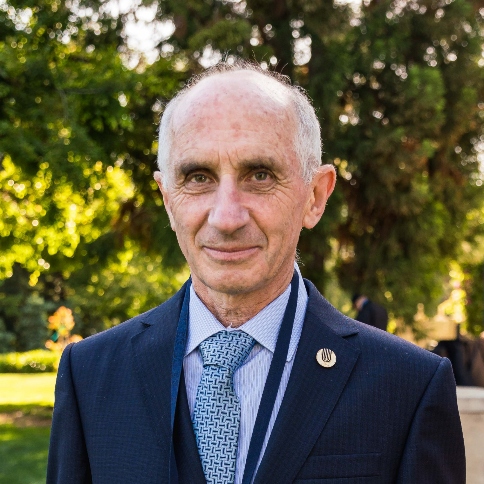
Adam Teman

Krill Prize 2020
Bar-Ilan University

Adam Teman


Title: Efficient Circuits and Systems Design for Electronic Chips


My research deals with the design of circuits and systems that are integrated on the silicon chips that can be found in virtually any electronic system today. In the framework of my research, I search for novel methods to improve these chips in order to enable smarter, faster, cheaper and more energy-efficient products. My research team, which operates from within the EnICS Labs center at Bar-Ilan University, focuses on a wide range of research domains, including embedded memory design, hardware for artificial intelligence applications, open hardware design for efficient digital computation and more. Our research work starts at the algorithm and computer architecture levels, crossing all levels of abstraction down to the circuit and transistor level, and includes the demonstration of our novelty upon components fabricated in state-of-the-art nanometer process technologies. The outcomes of our research are integrated in digital systems of all types, from the datacenter to the mobile unit and autonomous car.

Yasmine Meroz

Krill Prize 2020
Tel Aviv University

Yasmine Meroz


Physics of Growing Systems and Plant Behaviour


Though plants are literally rooted to the ground and cannot flee from predators or forage for nutrients, they thrive in a harsh and fluctuating environment thanks to their ability to sense stimuli and plan complex growth strategies. However, as opposed to animals, in plants sensory and computational systems are distributed at the tissue level, calling for a new conceptual framework. In the lab we study fundamental behavioral processes in plants, such as memory phenomena, decision-making, and collective behavior. We combine theory with experiment, inferring underlying computational rules underlying behavioural processes. This understanding is particularly important in the development of a novel autonomous robot inspired by the moving-by-growing capabilities of plants. The ultimate goal is to provide a multi-scale understanding of plant behavioral processes, relating its biological, physical and computational aspects.


Yakir Hadad

Krill Prize 2020
Tel Aviv University

Yakir Hadad


Going beyond physical bounds in wave systems


I find the physics of waves to be extremely intriguing. Together with my group and friends we learn waves in various complex media. Besides pure phenomena, as an engineer, I look for applications and seek to design better devices. For example, in order to increase data transfer rate, we need an antenna with larger bandwidth. However, there are always tradeoffs, for instance there is an upper bound on the bandwidth of a small antenna. One of the biggest challenges we work on is to find ways to overcome this kind of physical bounds. To that end we comprehensively learn the bound and its underlying assumptions, then we revoke on of these, and finally apply sophisticated optimization tools with lots of wave physics intuition. This way we design devices that are beyond today’s limitations.


Yonit Hochberg

Krill Prize 2020
Hebrew Univ.

Yonit Hochberg


The Dark Side of the Universe


Dr. Hochberg is a theoretical particle physicist, whose research focuses on fundamental questions about nature: What are we made of?


How did we get here? In this context, dark matter is perhaps the greatest mystery of modern physics: While it makes up 85% of the matter in our universe, its identity remains unknown. What is it made of? How does it interact? And why is it so dark? Dr. Hochberg works on new theoretical ideas for the particle identity of dark matter, and proposes groundbreaking novel methods to search for dark matter in the laboratory. Her research helps shed light on dark matter, opening a whole new window into the dark universe.

Zeev Abeles

Board of Trustees (BOT) Chairperson

Zeev Meir Abeles, born in 1947, married + 3.

Chair of the Wolf Foundation Board of Trustees.

Zeev has many years of experience in the field of auditing and supervising banks. In his various past positions, Zeev was Chairman of the Board of Directors of Union Bank, Chairman of the Board – Open University, Member of the Board and Chairman of the Finance Committee Izzy Shapira, Director of the Foreign Exchange Audit Unit, Director of Credit and Collateral Audit and Executive Board The senior member of the Bank of Israel. In addition, Zeev serves as a member of the Accounting Standards Board and the Securities Authority, the Tel Aviv Economic Development Authority board, Tzur Shamir Ltd., and the board of Etgar Investments and Development Ltd.

Dr. Talia Aharoni

Trustee

Talia Aharoni holds a PhD. in Practices and Theories from Paris 8 University. Her doctorate thesis, titled “Glocalization of Corporate Social Responsibility: The Development and Characterization of CSR in Israel”, was based on her experience as the founder of Maala – Business for Social Responsibility in Israel. Aharoni is an adjunct professor for CSR at The Recanatti School of Business, Tel-Aviv University, and COLMAN – College of Management; and an invited lecturer on CSR issues to a variety of academic institutions and conferences, both local and global. Aharoni’s present and past public engagements include: Trustee of the Wolf Foundation; Board member of: The Association for Civil Rights in Israel; Yedid – Association for Community Empowerment; Midot – Ranking and Analyzing NPO. Former member of: The Prime Minister’s cross partnership table; The GRI Stakeholders Council 2007-2013; MENA Network Global Compact 2007-2010; The Israeli committee for the ISO 26000; CSR Leaders Network. Served on the Board of Investec Bank Israel 1999-2004; Special advisor to Israel Minister of Finance 1997-1998.

Dalia Rabin

Trustee

Dalia Rabin – ADV. Worked in a private law firm and the Tel Aviv District Attorney’s Office. In 1980 Dalia joined the State Attorney’s Office and was an attorney at the Tel Aviv District Attorney’s Office for fourteen years. During her years working in the State Attorney’s Office, she dealt extensively with defense cases concerning the defense industries and the bodies of the defense establishment. In addition, Dalia served as legal counsel for the Histadrut trade union. She served as a Member of the Knesset in the 15th Knesset (1999-2003) and held several positions, including Deputy Speaker of the Knesset, Chair of the Ethics Committee, and served on other committees such as the Constitution, Law and Justice Committee, the State Audit Committee and the Committee for the Advancement of Women and the Special Committee for Promotion. Child status. As Deputy Minister of Defense (2002-2001) – the first woman in the State of Israel to fill this position, she was responsible for the home front issue, led to the establishment of the Chief Reserve Officer in the IDF, and worked hard to promote aid and compensation for reservists. Arbitration and Dispute Resolution “and heads it. In addition, she worked to establish the” Yitzhak Rabin Center “house, serves as chairman of the center’s executive committee, and is responsible for organizing the annual rallies in his memory. In addition to her work as head of the center, Dalia contributes from her professional experience in various public bodies, including a trustee member at the Wolf Foundation, board member of directors of the Israeli Center for Citizen Empowerment, member of the board of directors, and the steering committee at the Reut Policy Planning Institute, the Israel-America Friendship League board. A member of the board of trustees of the Association for the War on Cancer, a member of the board of directors of the JL Association – Learning Bridges for Diagnosing and Treating Learning Disabilities, and others.

Caroline Dean

Wolf Prize Laureate in Agriculture 2020

Caroline Dean


Affiliation at the time of the award:

John Innes Centre, England, UK


Award citation:

“for pioneering discoveries in flowering time control and epigenetic basis of vernalization.”


Prize share:

None


As winter gives way to spring, as if by clockwork, many plants bloom in all their glory in order to attract pollinators. These species delay their flowering until the onset of spring, when there are optimal conditions  for fertilization. It has been long known that plants delay flowering until they have experienced a period of prolonged cold, a process termed vernalization. Prof. Dean’s work on understanding the plant’s memory mechanisms and temperature sensing, has many implications for agriculture and extending crop range to ensure year-round supply.

Professor Dean (Born 1957) grew up in the north of England. After gaining both a BA and a PhD in Biology at the University of York, Caroline moved to California to research molecular biology. She began working at the John Innes Centre in 1988, where she works on the molecular basis of vernalization.

Dean’s research has provided several major breakthroughs that have direct impact on our understanding of a fundamental process in biology that is of critical importance to society, namely the molecular mechanism controlling the timing of flowering in higher plants. Her research was focused around two central questions in plant biology: Why do certain plants have to pass through winter before they bloom, and how do they remember that they have been exposed to cold temperatures weeks or months earlier? These are not merely academic problems, because the breeding of different varieties of cereals that either have or do not have this winter requirement has been a major cornerstone for increasing the yield of agricultural crops in temperate climates. Dean and her students cloned several of the most important genes controlling Arabidopsis flowering time in response to vernalization, the process by which plants recall temperature to regulate flowering in the correct season.

In attempts to understand the mechanisms by which the vernalization pathway operates, Dean and coworkers have discovered an epigenetic mechanism that regulates the pathway, linking RNA processing with small RNA silencing pathways and histone demethylation. Together with collaborators they then developed a quantitative molecular model explaining how plants “remember” winter. Her seminal research describes the mode by which plants extract signals from noisy temperature profiles, and how this is remembered through subsequent development. Dean has translated her basic research from Arabidopsis thaliana into crop biology as well, especially by breeding of various Brassicas that have flowering time alleles chosen by molecular methods based on her basic research. Dean’s work provides a molecular paradigm for environmentally-controlled epigenetic regulation with enormous ramifications for breeding crops in stressful and changing environments.

Caroline has been a strong advocate for women in science, and enthusiastic role model and mentor. Dean’s work and its implications for agriculture have gained increasing currency in the face of a changing climate, which have been of profound importance not only for agriculture, but also for biology as a whole.


Allan H. MacDonald

Wolf Prize Laureate in Physics 2020

Allan H. MacDonald


Affiliation at the time of the award:

The University of Texas at Austin, USA


Award citation:

“For pioneering theoretical and experimental work on twisted bilayer graphene.”


Prize Share:

Allan H. MacDonald 

Pablo Jarillo-Herrero

Rafi Bistritzer


Since the 2004 groundbreaking experiments regarding the two-dimensional material -graphene, several research groups were soon studying the properties of twisted bilayer graphene. Graphene is a significant foundation for an entirely new generation of technologies. The hope is that graphene-based applications will benefit the environment and reduce costs. Electronic and computer industry requires materials whose conductance can be controlled.

The work of Jarillo-Herrero, MacDonald and Bistrizer has shown that the conductance properties of graphene interfaces can be controlled via the spatial misfit angle between the layers and then at certain angles the electrons exhibit surprising physical behavior. This physical discovery has the potential of leading to an energy revolution.

In 2011, a group led by Allan Macdonald, a theoretical physicist from the University of Texas, researched an intriguing behavior of twisted bilayer graphene, where the atomic lattices of two stacked graphene layers are laterally rotated with respect to each other by a small misfit angle. According to the calculations of MacDonald and Bistrizer (who did his post-doctoral thesis under the supervision of MacDonald at that time), the tunneling velocity of electrons between the layers depends on the misfit angle and completely vanishes at the “magic angle” of 1.1 degrees. It was hoped that this discovery would lead to the creation of a new type of super-conductor, namely a material that allows electrical current to pass with no impedance and with no energy loss.

The original paper by MacDonald and Bistrizer, which describes their discovery, was not received with enthusiasm by the scientific community and was even forgotten for several years.

At the same time, Jarillo-Herrero was working on twisted bilayer graphene in his lab at MIT. He became convinced that the ideas expressed by Macdonald and Bistrizer had substance.

His research team  therefore invested considerable efforts in creating and measuring twisted bilayer graphene of various twist angles. The experiments proved successful in 2017 when it was found that positioning the layers at an angle of 1.1 degrees relative to one another (“the magic angle”) resulted in unusual electrical properties, precisely as MacDonald and Bistrizer have suggested. In this position, at sufficiently low temperatures, the electrons move from one layer to the other, creating a lattice with unusual qualities. The paper that described the phenomenon, which was published in Nature in 2018, revolutionized physics and triggered a flood of additional papers.

The discovery opens the door to building a super-conductor from bilayer graphene, in which electron movement is completely controlled by external electrical current. This electrical behavior resembles the behavior of copper-based superconductors called Cuprates. Cuprates demonstrate electrical conductivity with no resistance in relatively high temperatures compared with other super-conductors. For this reason, Cuprates now form a source of hope for realizing the dream of electrical conductivity with no energy loss at temperatures close to room temperature. If this mission is achieved, it would lead to a far-reaching energy revolution. However, one obstacle that prevents this revolution is that we do not yet have a theory that explains the behavior of superconductors at high temperatures. In the absence of a solid theoretical foundation, it is difficult to develop new, better materials. This is one of the reasons for the excitement around the discovery of bilayer graphene and the magic angle, which allows us to understand better what happens on the microscopic level when transitioning from a conductor to a superconductor state.

Allan H. MacDonald (1951, Canada) received the B.Sc. degree from St. Francis Xavier University, Antigonish, Nova Scotia, Canada in 1973 and the M.Sc. and Ph.D. degrees in physics from the University of Toronto in 1974 and 1978, respectively. He was a member of the research staff of the National Research Council of Canada from 1978 to 1987 and has taught at Indiana University (1987-2000) and the University of Texas at Austin (2000-present) where he now holds the Sid W. Richardson Chair in Physics. He has contributed to research on the quantum Hall effect, electronic band structure theory, magnetism, and superconductivity among a variety of other topics. Prof. MacDonald is a fellow of the American Physical Society, a member of the American Academy of Arts and Sciences and the US National Academy of Sciences, and a recipient of the Herzberg Medal, the Ernst Mach Honorary Medal, and the Buckley Prize.

Yakov Eliashberg

Wolf Prize Laureate in Mathematics 2020

Yakov Eliashberg


Affiliation at the time of the award:

Stanford University, USA


Award citation:

“for their contributions to differential geometry and topology.”


Prize Share:

Yakov Eliashberg

Simon Donaldson 


Yakov Eliashberg is one of the founders of symplectic and contact topology, a discipline originated as mathematical language for qualitative problems of classical mechanics, and having deep connections with modern physics. The emergence of symplectic and contact topology has been one of the most striking long-term advances in mathematical research over the past four decades. Eliashberg is among the main exponents of this development.

Professor Eliashberg was born in 1946 in Leningrad (now St. Petersburg), Russia. He received his doctoral degree in Leningrad University in 1972 under the direction of V.A. Rokhlin, and in the same year he joined Syktyvkar University in northern Soviet Union. Eliashberg’s route passed through the refusenik years in Leningrad (1980-1987) where he had to do software engineering in order to feed his family, and where he was virtually cut off from normal mathematical life. In 1988 he emigrated to the United States and in 1989 became a Professor at Stanford University. He is a Member of U.S. National Academy of Sciences. For his contributions, Eliashberg has received a number of prestigious awards, including the Guggenheim Fellowship in 1995, the Oswald Veblen Prize in 2001, the Heinz Hopf Prize in 2013 and the Crafoord Prize in 2016. Eliashberg is currently the Herald L. and Caroline L. Ritch Professor at Stanford University.

Eliashberg developed a highly ingenious and very visual combinatorial technique that led him to the first manifestation of symplectic rigidity: the group of symplectomorphisms is closed in the group of all diffeomorphisms in the uniform topology. This fundamental result, proved in a different way also by Gromov and called nowadays the Eliashberg-Gromov theorem, is considered as one of the wonders and cornerstones of symplectic topology. In a series of papers (1989-1992), Eliashberg introduced and explored a fundamental dichotomy “tight vs overtwisted” contact structure that shaped the face of modern contact topology. Using this dichotomy, he gave the complete classification of contact structures on

the 3-sphere (1992). In these papers Eliashberg laid foundations of modern contact topology and introduced mathematical language which is widely used by researchers in this rapidly developing field.

In a seminal 2000 paper Eliashberg (with Givental and Hofer) pioneered foundations of symplectic field theory, a powerful, rich and notoriously sophisticated algebraic structure behind Gromov’s pseudo-holomorphic curves. It had a huge impact and became one of the most central and exciting directions in symplectic and contact topology. It has led to a significant progress on numerous areas including topology of Lagrangian submanifolds and geometry and dynamics of contact transformations, and it exhibited surprising links with classical and quantum integrable systems.

In recent years (2013-2015), Eliashberg found a number of astonishing appearances of homotopy principle in symplectic and contact topology leading him to a solution of a number of outstanding open problems and leading to a “mentality shift” in the field. Before these developments the consensus among experts was that the symplectic world is governed by rigidity coming from Gromov’s theory of pseudo-holomorphic curves or, equivalently, by Morse theory on the loop spaces of symplectic manifolds. The current impression based on Eliashberg’s discoveries is that rigidity is just a drop in the ocean of flexible phenomena.

Professor Yakov Eliashberg is awarded the Wolf Prize for his foundational work on symplectic and contact topology changing the face of these fields, and for his ground-breaking contribution to homotopy principles for partial differential relations and to topological foundations of multi-dimensional complex analysis.